Every week, millions of bins are wheeled to the kerb across the country. But what happens after the lorry drives away? This guide reveals the fascinating journey your discarded items take.
From household bins to sophisticated facilities, a complex system handles our nation’s waste. It transforms old materials into valuable resources for new products.
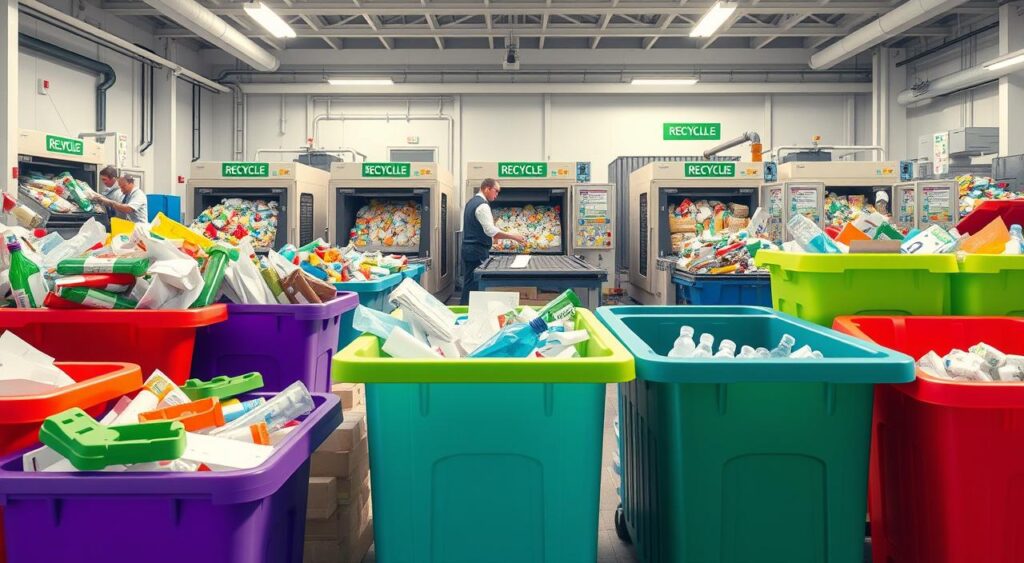
The process involves several key stages. These include collection, advanced sorting, and reprocessing. Each step relies on modern technology and infrastructure.
Understanding this system provides essential information. It helps everyone participate more effectively. This reduces contamination and supports a sustainable, circular economy.
Key Takeaways
- The journey from your bin to a new product involves multiple stages of collection, sorting, and reprocessing.
- The UK handles millions of tonnes of waste materials every year through an extensive national infrastructure.
- Different materials, such as plastic, glass, paper, and metals, each follow specific reprocessing paths.
- Households and businesses play a critical role by sorting items correctly before collection.
- Reducing contamination in recycling bins is vital for the system’s overall efficiency and success.
- A deeper understanding of the process empowers individuals to contribute to a more sustainable future.
Introduction to Recycling in the UK
Statistics paint a clear picture: the nation’s appetite for convenience creates a vast tide of used packaging. Managing this flow is a central challenge for environmental and economic health.
Why Recycling Matters Today
Transforming waste into resources is vital. It conserves raw materials, saves energy, and cuts greenhouse gas emissions. This supports national climate goals and builds a more resilient circular economy.
Economically, it creates jobs in collection, sorting, and manufacturing. Proper management also reduces costs associated with landfill and pollution.
An Overview of the UK Recycling Landscape
Recent data reveals the scale. Each home discards around 60 pieces of plastic packaging weekly. This sums to a staggering 90 billion items annually.
The number places the UK second globally for per-person plastic waste. Yet, only 43% of household plastic gets collected for recycling. This highlights a major gap.
While participation is growing, understanding the full recycling process lags. Knowing the journey from bin to new products is key to boosting the rate of success.
Collections have expanded, but what’s accepted varies by council. Public action remains crucial to improve the system’s efficiency for all materials.
Understanding Collection Systems in the UK
The backbone of the nation’s waste recovery effort is its diverse array of collection methods. Each system is designed to capture specific materials efficiently.
Knowing where to place your discarded items is the first crucial step. This ensures they enter the correct reprocessing stream.
Kerbside and Local Recycling Centres
Kerbside collection is the most convenient service for households. Local authorities or their contractors collect from individual bins on scheduled days.
This method yields high participation. Residents simply place approved containers and packaging into their recycling bin.
For larger waste or specific plastic objects like furniture, local recycling centres provide drop-off points. They accept electrical goods and other bulky items.
Role of Transfer Stations
Collected material often goes to a waste management transfer station first. Here, loads are consolidated for efficient transport.
This bulking process reduces haulage costs. It streamlines logistics before materials reach larger processing plants.
| Collection Method | Accepted Materials | Primary Purpose |
|---|---|---|
| Kerbside Collection | Plastic bottles, glass, paper, cans | Regular, convenient household pickup |
| Local Recycling Centres | Bulky plastic, electronics, garden waste | Drop-off for non-standard items |
| Transfer Stations | All collected recyclables and waste | Consolidation and logistical hub |
| Supermarket Drop-offs | Flexible plastic packaging, carrier bags | Supplementary collection for specific films |
Alternative points include front-of-store recycling at supermarkets. Some councils use these sites for flexible plastic film.
Using the right bin or centre prevents contamination. This keeps the entire system running smoothly.
How recycling works UK: A Step-by-Step Guide
From kerbside to factory, a series of well-defined steps ensures materials are recovered. This journey turns collected items into new resources through a coordinated industrial process.
Collection and Initial Sorting
Discarded materials are first deposited into the correct bins. Local crews gather this mixed waste from households and businesses.
The loads often travel to a transfer station. Here, they are consolidated for efficient haulage to a specialised facility.
Transport to Recovery Facilities
The next destination is a Material Recovery Facility (MRF). This is the primary hub for sorting. Vehicles deliver their mixed contents to these plants.
At the recovery facility, the bulk waste is unloaded. It is then prepared for the detailed separation phase.
Reprocessing Routes and Final Product
Inside the MRF, items move along conveyor belts. Machines and workers separate them into distinct types, such as plastic, paper, and metals.
Each material stream follows a specific recycling process. For instance, plastic is washed, ground into flakes, and melted.
It is then formed into uniform pellets. These become raw feedstock for manufacturers of new products. This completes the loop from discarded item to useful resource.
Advanced Sorting and Processing Techniques
The true magic of material recovery happens within high-tech plants equipped with cutting-edge sorting technologies.
These systems ensure different materials are accurately separated for reprocessing.
Optical Sorting Machines and NIR Technology
Optical sorting machines use Near Infrared (NIR) sensors. They scan items on a fast conveyor belt.
The sensor identifies each plastic type by its unique light signature. Precise air jets then blow plastics into correct chutes.
Magnetic Separation and Eddy Currents
Powerful magnets remove ferrous metal like steel cans from the stream. This is a dry process.
Eddy current separators handle non-ferrous metals. Rotating magnets create a field that repels aluminium away from other materials.
Sink-Float Separators in Wet Processing
This method uses water tanks to sort plastic by density. Heavy types sink, while lighter ones float.
It provides a physical separation that complements optical scanning.
| Technology | Separation Principle | Target Materials |
|---|---|---|
| Optical Sorter (NIR) | Light absorption signature | Plastic types (PET, HDPE, PVC) |
| Magnetic Separator | Magnetic attraction | Ferrous metals (steel) |
| Eddy Current Separator | Electromagnetic repulsion | Non-ferrous metals (aluminium, copper) |
| Sink-Float Separator | Density in water | Plastics by density |
Modern facility combines these machines in sequence. This achieves the pure materials needed for new manufacturing.
Effective recycling depends on this advanced sorting. It maximises the recovery of valuable plastic and metal.
Recycling Infrastructure and Facilities
Transforming collected items into usable resources depends on two distinct types of processing centres. These industrial plants form the critical backbone of the recovery system.
Material Recovery Facilities (MRFs)
A Material Recovery Facility, or MRF, is the first major stop for mixed collections. Here, a combination of machinery and manual labour separates the stream.
Paper is divided from glass, metals from plastic. The goal is to create clean batches of specific materials for the next stage.
Plastic Recovery Facilities (PRFs)
These specialised centres focus solely on plastics. Advanced optical sorters identify different resin types by their light signature.
This technology separates PET bottles from HDPE tubs and film. It ensures each plastic type follows the correct reprocessing process.
The scale of domestic operations is significant. Over 80% of collected glass is used in Britain, with the majority making new bottles.
All UK newsprint now contains 100% recycled paper. This demonstrates effective closed-loop systems.
Success requires seamless coordination. Collection companies, facility operators, reprocessors, and manufacturers must work in unison.
Some reprocessors even have “mini PRFs” for extra quality checks. Ongoing challenges include managing waste contamination and finding stable markets for processed materials.
Recycling of Different Materials in the UK
Each material we discard follows a unique path back to usefulness, dictated by its inherent properties. The system treats plastic, glass, paper, and metals very differently.
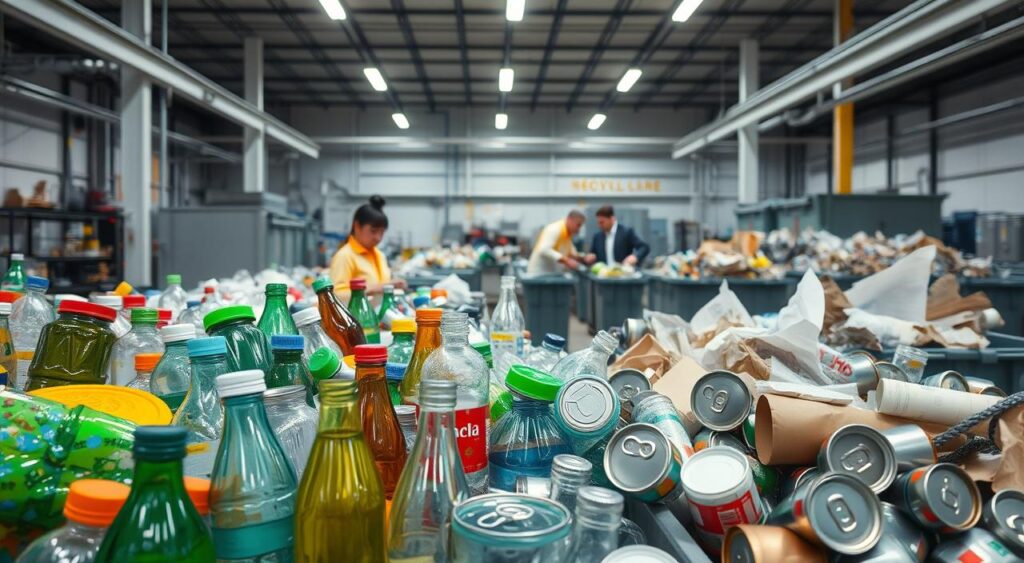
Plastics and Their Resin Codes
Small numbers inside arrows on packaging denote the plastic type. PET and HDPE drinks bottles have a very high recovery rate.
Clear PET bottles are most valuable. They can be identified as food-grade and turned into new drinks bottles. Major manufacturers now use clear plastic for this reason.
Other types face challenges. PP pots can be recycled but not back into food packaging. They often become non-food products.
Glass, Paper, and Metals Recycling
Glass is infinitely recyclable. Most collected glass is processed in the UK. A green wine bottle often contains a high percentage of recycled material.
Paper and card form the largest stream at sorting plants. UK-made paper frequently uses recycled fibre.
Steel cans are removed by magnets. Aluminium is separated by eddy currents. Recycling aluminium uses only 5% of the virgin energy.
Comparing Recycled versus Virgin Materials
Using recycled materials saves significant energy. While some plastic has limits, glass and metal can loop endlessly without quality loss.
Addressing Food Waste and Waste Management
A significant portion of what ends up in our bins is not packaging, but leftover food and garden trimmings. Managing this organic waste stream is a critical part of national waste management. Households generate 6.64 million tonnes of food waste annually.
This represents 60% of the UK’s total. When sent to landfill, it produces methane, contributing to climate change.
Food Waste Collection and Treatment
Currently, treatment of this food stream is inconsistent. Only 17% gets composted or processed by anaerobic digestion. A quarter still goes to sewer or landfill.
Anaerobic digestion is the optimal process. Micro-organisms break down food in oxygen-free tanks. This creates biogas for energy and a nutrient-rich fertiliser.
Collection services vary widely. Wales and Northern Ireland have mandatory schemes. Most Scottish councils offer a service.
Around half of English councils currently provide no food waste collection. This will change when collections become mandatory by March 2026.
Impact on Overall Recycling Efficiency
Garden waste follows a separate path. It undergoes industrial composting for about 16 weeks. The finished compost is used in agriculture.
Food contamination severely impacts other recycling. Residue on plastic can fool sorting machines. Dirty items may be sent for disposal instead of recovery.
A simple rinse of packaging makes a major difference. Clean materials are easily identified at sorting plants. This simple act boosts the quality of the final products.
Reducing food waste at source is the top priority. Unavoidable scraps should go into the correct recycling bin or caddy. This captures their value and prevents harmful emissions.
Practical Tips for Better Recycling Practices
Households hold the key to improving the quality and quantity of materials recovered from the waste stream. Simple preparation steps make a huge difference at sorting plants.
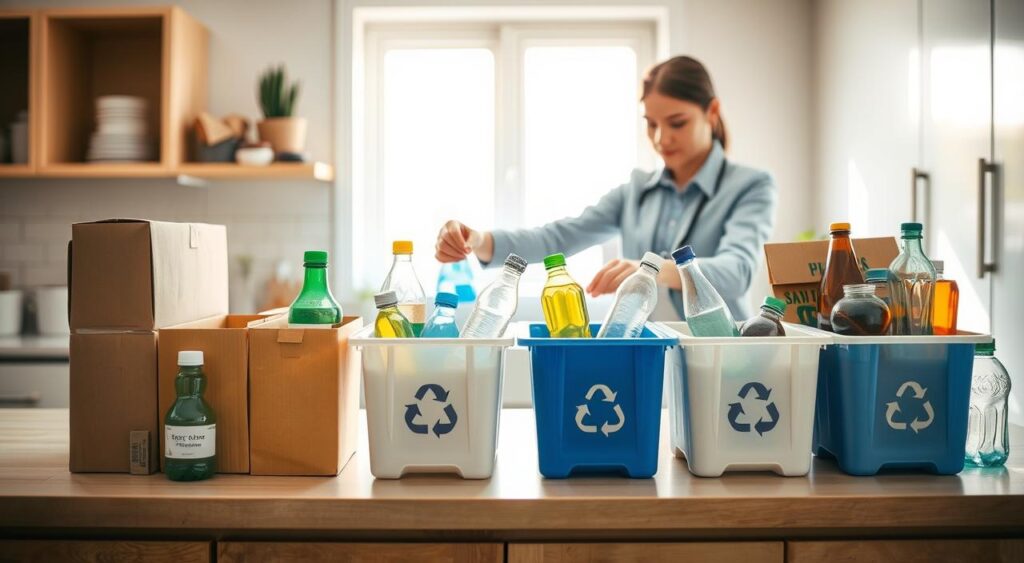
Proper Sorting and Rinsing Guidelines
Always screw plastic lids back onto bottles. Small pieces under 40mm get lost in machinery. Squash bottles to save space and stop them rolling.
Give containers a quick rinse. They don’t need to be spotless, but major food residue spoils paper and card. Balance this with water conservation.
Never put battery-containing items in your bin. Lithium-ion cells cause dangerous fires at facilities. Take them to dedicated points.
| Material | Key Action | Reason |
|---|---|---|
| Plastic Bottles | Screw lid on, squash flat | Prevents loss, saves space |
| Food Cans | Empty and rinse lightly | Prevents contamination |
| Glass Jars | Leave lids on | Safer handling |
| Aluminium Foil | Scrunch into a ball | Detected by sorting machines |
How to Reduce and Reuse Waste Effectively
Reducing waste is better than recycling it. Choose reusable water bottles and coffee cups. Buy loose fruit and vegetables without packaging.
Support zero-waste shops with refillable containers. Consider milk delivery using returnable glass bottles. Opt for simple, single-material packaging over complex types.
Conclusion
By grasping the journey our discarded items take, we unlock the potential to close the loop on waste. This entire process, from bin to new products, relies on seamless coordination.
Households, collection crews, and advanced recovery facility teams all play a part. Sophisticated sorting gives materials like plastic, glass, paper, and metal a second life.
Effective waste management hinges on public action. Simple steps, like rinsing containers, boost the recycling rate and material quality for manufacturers.
While recycling is vital, reducing consumption remains the top priority. Every conscious choice conserves resources and builds a more sustainable future.