How much waste does London produce every day? It is a question many residents, businesses, and policymakers ask when trying to understand the environmental challenges facing the UK’s capital. Every day, thousands of tonnes of materials are collected, transported, sorted, recycled, or disposed of across the city.

Understanding how much waste London produces every day helps reveal the scale of the challenge and the importance of sustainable waste management strategies. From household rubbish and commercial refuse to construction debris, London generates enormous volumes of materials that must be managed efficiently.
As the city continues to grow, improving recycling systems and reducing landfill use has become a key priority for local authorities and environmental organisations.
Key Takeaways
- London generates thousands of tonnes of material every day from households, businesses, and construction sites.
- Commercial and industrial activities contribute roughly one-third of total waste generation in the capital.
- Recycling rates remain below national averages but are gradually improving.
- City leaders aim to achieve 65% recycling by 2030.
- Construction waste has one of the highest recovery rates, exceeding 90%.
- Policy changes and infrastructure investments are reshaping the city’s waste management system.
Understanding London’s Waste Management System
Waste management in London has evolved dramatically over the past few decades. In the 1990s, most rubbish generated in the capital was sent directly to landfill sites outside the city.
At the time, the UK had around 1,500 active landfill locations. One of the most well-known was Mucking Marshes in Essex, which became the largest landfill site in Europe.
Large barges transported waste along the River Thames to the site, a process that symbolised London’s dependence on landfill disposal.
However, this approach began to change due to environmental concerns and new economic policies.
One of the most important developments was the introduction of landfill taxes, which significantly increased the cost of dumping rubbish. As a result, the city began investing in alternative solutions such as recycling infrastructure and energy-from-waste facilities.
Today, London’s waste management system includes:
- Materials recovery facilities
- Recycling centres
- Anaerobic digestion plants
- Energy-from-waste incinerators
These facilities form a complex network designed to process the city’s massive waste streams more efficiently.
Daily Waste Generation in London
When annual waste statistics are broken down into daily figures, the scale of the challenge becomes clearer.
Across England, households generated 21.7 million tonnes of waste in 2023. This equals approximately 59,000 tonnes per day nationwide.
London contributes a substantial portion of this total because of its population of nearly nine million people and its massive commercial sector.
The city’s waste generation fluctuates throughout the year depending on:
- Seasonal consumption patterns
- Holiday periods
- Construction activity
- Economic conditions
These daily flows place constant pressure on collection services, recycling plants, and treatment facilities.
Systems such as the UK’s WasteDataFlow platform track waste from collection to final treatment, allowing authorities to monitor trends and plan future infrastructure investments.
Household Waste and Recycling Performance
Household rubbish represents a significant portion of municipal waste in London. This includes materials collected from:
- Kerbside bins
- Recycling containers
- Local recycling centres
Recent figures show that household waste levels have increased slightly across England.
In 2023, total household waste rose by about 1.2%, while recycling rates improved only modestly.
England’s recycling rate reached 44%, still below long-term environmental targets.
Organic materials such as garden waste showed the biggest improvement due to expanded collection services and better growing conditions.
However, recycling of dry materials like plastics and paper has stagnated in many areas.
This highlights the need for stronger public engagement and improved recycling infrastructure.
Packaging Waste Recovery Trends
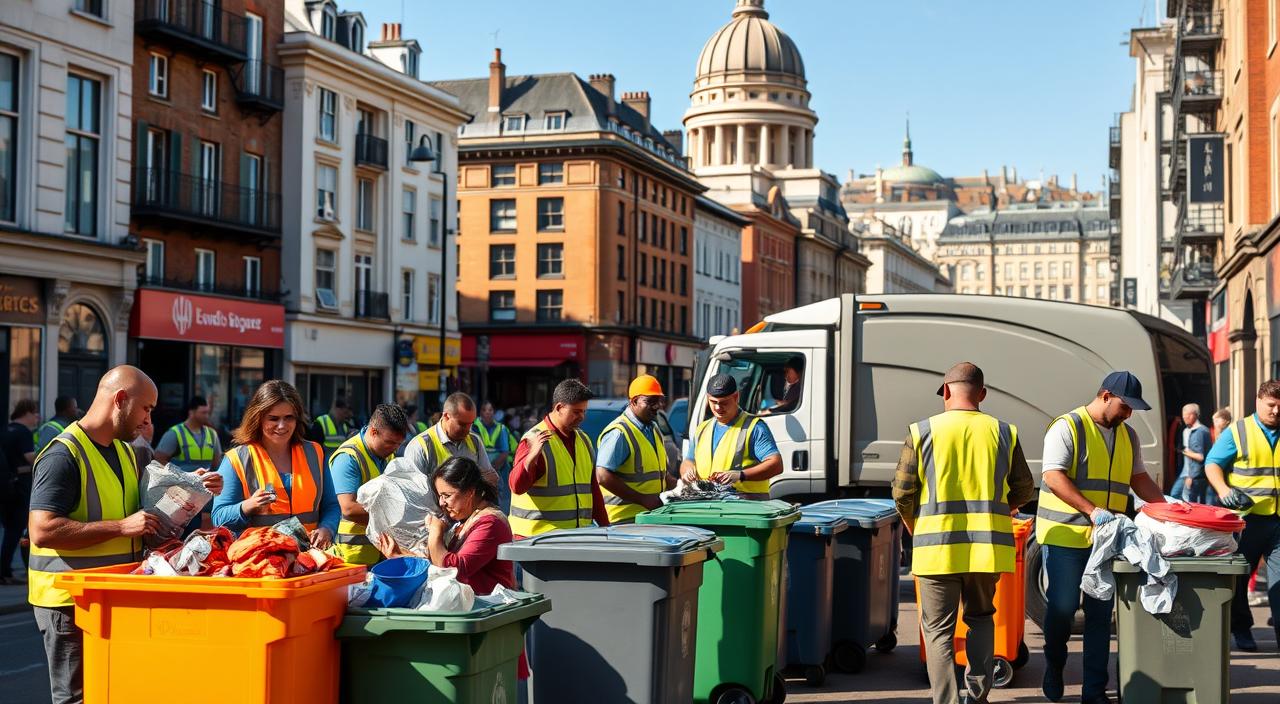
Packaging waste remains one of the most visible components of household rubbish. From cardboard boxes to plastic containers, packaging makes up a large proportion of everyday waste streams.
Recent data highlights how recovery rates differ depending on the material type.
| Material | Recycling Performance |
|---|---|
| Paper & Cardboard | High recovery due to well-established collection systems |
| Metals | Strong recycling rates because materials retain value |
| Plastics | Lower recovery rates due to complex processing |
| Wood | Often diverted to energy recovery rather than recycling |
Paper and cardboard remain the easiest materials to recycle due to efficient sorting systems and strong demand from manufacturers.
Plastic packaging remains one of the most challenging materials because different polymers require specialised processing.
Comparing Major Waste Streams
Waste generated across the UK can be divided into three major categories:
- Household waste
- Commercial and industrial waste
- Construction and demolition waste
Each stream has unique characteristics and management challenges.
| Waste Category | Annual Volume (UK Estimate) |
|---|---|
| Household | ~26 million tonnes |
| Commercial & Industrial | ~40 million tonnes |
| Construction & Demolition | ~59 million tonnes |
Construction waste represents the largest stream by volume. However, it also has the highest recycling rates due to efficient on-site sorting practices.
Commercial and Industrial Waste
Businesses play a major role in waste generation across the capital. Offices, restaurants, retailers, and factories all produce different types of waste.
In the UK, commercial and industrial activities generate over 40 million tonnes annually.
London alone contributes a large share of this due to its concentration of economic activity.
Typical business waste includes:
- Packaging materials
- Food waste from hospitality venues
- Office paper and electronics
- Industrial by-products
Managing these streams requires cooperation between businesses, private waste contractors, and regulatory bodies.
Companies are increasingly encouraged to adopt sustainable practices such as waste audits, recycling programmes, and resource-efficient procurement.
The Role of Local Authorities
Local councils play a central role in waste management across London. Their responsibilities include organising collection services and maintaining recycling facilities.
Key duties include:
- Kerbside waste collection
- Operation of recycling centres
- Enforcement of waste regulations
- Monitoring waste data
Local authorities also implement initiatives designed to improve recycling performance.
For example, many boroughs have introduced separate food waste collections to divert organic materials from landfill.
These programmes are often supported by national data systems such as WasteDataFlow, which allow authorities to monitor performance and report progress.
Waste Treatment and Processing Infrastructure

Modern waste treatment relies on several specialised technologies.
Materials recovery facilities sort recyclable materials using mechanical and optical systems.
Organic waste can be processed in anaerobic digestion plants, where microorganisms break down food waste to produce biogas and fertiliser.
Another major component of the system is energy-from-waste plants. These facilities burn non-recyclable materials to generate electricity and heat.
While this approach reduces landfill use, it remains controversial because of concerns about emissions and resource efficiency.
Despite these debates, energy-from-waste facilities now handle a large proportion of London’s residual waste.
Construction and Demolition Waste
The construction sector generates massive volumes of waste due to building projects, infrastructure upgrades, and property demolitions.
However, this sector also demonstrates some of the best recycling performance.
Materials such as:
- Concrete
- Metals
- Bricks
- Timber
are often recovered and reused.
Crushed concrete can be used as aggregate for new construction projects, while metals are recycled through established industrial supply chains.
Because of these practices, construction waste recovery rates regularly exceed 90%, making it one of the most successful recycling sectors.
Sustainability Targets for London
London has established ambitious environmental goals to reduce waste and improve recycling.
Key targets include:
- Achieving 65% recycling by 2030
- Reaching 50% recycling by 2025
- Reducing food waste by 50% per person
These targets form part of the city’s broader transition toward a circular economy.
A circular system aims to keep resources in use for as long as possible through reuse, repair, and recycling.
Initiatives supporting this transition include public awareness campaigns, improved recycling services, and partnerships with businesses.
Waste Generation During the COVID-19 Pandemic
The COVID-19 pandemic significantly changed waste patterns across the UK.
During lockdowns, household waste increased as people spent more time at home. At the same time, commercial waste declined due to business closures.
Recycling services also faced operational challenges, including staff shortages and safety restrictions.
Although recycling rates temporarily declined during the pandemic, they have gradually begun to recover as normal services resumed.
London Compared with National Recycling Trends
Despite improvements, London’s recycling rate remains lower than the national average.
Urban density creates challenges such as limited storage space for recycling bins and higher numbers of apartment buildings.
Comparing recycling rates across the UK highlights these differences.
| UK Region | Recycling Rate |
|---|---|
| Wales | 57% |
| Northern Ireland | 50% |
| England | 44% |
| Scotland | 42% |
London’s rate sits below these figures, demonstrating the need for targeted strategies in dense urban environments.
What Businesses Can Do to Reduce Waste
Businesses in London have a major opportunity to reduce their environmental impact.
Practical steps include:
- Conducting waste audits
- Improving recycling systems in offices and shops
- Reducing packaging
- Training staff on sustainability practices
Food waste reduction is particularly important for restaurants and retailers. Surplus food can often be donated or processed through anaerobic digestion rather than sent to landfill.
Businesses that adopt sustainable waste practices often benefit from reduced disposal costs and improved environmental reputation.
Conclusion
Understanding how much waste London produces every day reveals the enormous scale of the city’s waste management challenge.
Millions of tonnes of materials are generated annually by households, businesses, and construction projects. While recycling rates are improving, the capital still faces significant obstacles compared with national averages.
Encouragingly, progress is being made through improved infrastructure, policy changes, and growing awareness of environmental issues.
The future of waste management in London depends on adopting circular economy principles that prioritise reduction, reuse, and recycling.
With coordinated efforts from governments, businesses, and residents, the capital can continue moving toward a more sustainable and resource-efficient future.