Over the past half-century, the issue of discarded materials has transformed dramatically. What was once a localised concern for towns and cities has exploded into one of humanity’s most pressing environmental challenges.
The scale is staggering. Recent figures show the planet now produces over 2.01 billion tonnes of municipal solid waste every year. On average, each person creates around 0.74 kilograms daily. This figure hides a vast range, from 0.11 to 4.54 kilograms per person.
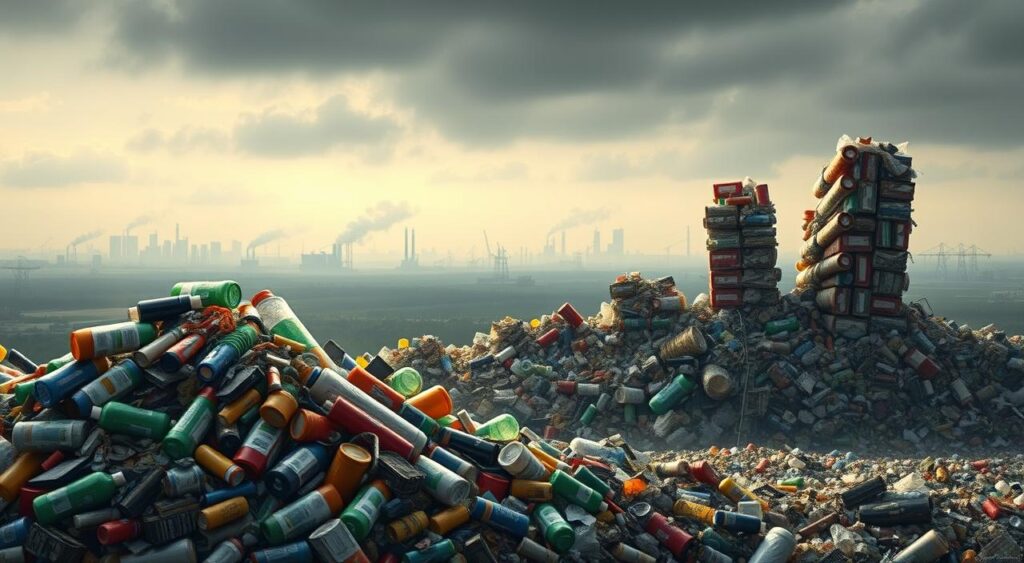
A significant disparity exists between nations. High-income countries, home to just 16% of the planet’s people, account for roughly 34% of the total. That equals about 683 million tonnes annually.
This surge is driven by several interconnected factors. Population expansion, rapid urbanisation, and shifting consumption habits all play a role. Economic development across different regions has further accelerated the trend.
Key Takeaways
- The volume of municipal solid waste has increased exponentially over five decades.
- Current annual production exceeds two billion tonnes worldwide.
- Daily per capita figures vary enormously between different regions and economies.
- Wealthier nations generate a disproportionate share relative to their population size.
- Population growth, urbanisation, and changing consumption are primary drivers.
- Understanding this historical trend is crucial for addressing future sustainability.
Introduction to Global Waste Trends
The patterns of what we throw away tell a profound story about societal and economic change. Analysing these trends over 50 years is crucial for policymakers, scientists, and the public. It helps us understand the scale of our challenge and plan effective responses.
Scope and Relevance of the Analysis
This report examines solid refuse from households, commerce, industry, and construction. It looks at all regions and income levels. The half-century view is vital because consumption and industrial processes have transformed since the 1970s.
Currently, a staggering 33% of the world’s annual output is not handled safely. This poses direct risks to health and the environment. Understanding this history is key to building a sustainable future.
Key Questions Driving the Report
Several critical inquiries guide this analysis:
- How has material production grown compared to economic and population expansion?
- What are the main factors pushing increased discard rates?
- How do patterns differ between developed and developing countries?
- Can we achieve prosperity without a proportional rise in refuse?
These questions are urgent. Total worldwide output is projected to hit 3.40 billion tonnes by 2050. This rise will more than double the rate of population growth, making this analysis essential context for modern environmental policy.
Historical Developments in Waste Generation
Historical analysis reveals a clear trajectory of increasing material output linked to economic progress. This development is not linear. Studies show a strong link between affluence and discard rates.
At the lowest income levels, output initially decreases. It then rises sharply as earnings grow. This pace slows in wealthier nations.
Milestones Over the Last 50 Years
The 1970s and 80s saw a consumer boom. Disposable products and plastic packaging became commonplace. This established refuse management as a key policy area.
The 1990s brought environmental awareness. Recycling programmes and international frameworks emerged. The issue was recognised as a worldwide concern.
The 2000s were a turning point. Rapid industrialisation in Asia, like China and India, surged volumes. The geographic centre of this growth shifted dramatically.
Shifts in Consumption and Disposal Practices
Consumption moved from durable goods to single-use items. Plastic packaging exploded. New categories like electronic waste appeared from tech advances.
Food discard also increased with modern retail. Disposal evolved from open dumping to complex systems. These now include recycling, composting, and energy recovery.
High-income nations tackled this earlier. Middle and low-income countries now face a dual challenge. They must manage rising volumes while building infrastructure from scratch.
Regional Variations in Waste Production
Not all regions contribute equally to the planet’s mounting refuse problem. The disparities in material output are dramatic and closely tied to economic development.
Divergences Between High-Income and Low-Income Countries
Affluent nations produce far more per person. Daily per capita rates can exceed 2 kilograms in wealthy countries. In poorer nations, they often fall below 0.2 kilograms.
Projections show this gap will evolve differently. Daily per capita discard in high-income countries may rise 19% by 2050. In lower-income nations, it could surge over 40%.
Case Studies: East Asia, Sub-Saharan Africa and the EU
East Asia and the Pacific account for 23% of the world’s total. This is driven by large populations and rapid industrialisation.
Sub-Saharan Africa has low per person output now. Yet its total refuse is set to triple by 2050. This poses major infrastructure challenges.
The European Union presents a different picture. Construction and mining dominate the total volume. Households contribute less than 9%.
| Region | Current Share of World’s Waste | Projected Growth by 2050 |
|---|---|---|
| East Asia & Pacific | 23% | Rapid increase |
| Sub-Saharan Africa | 6% (approx.) | More than triple |
| Middle East & North Africa | 6% | Double |
| European Union | ~10% (estimated) | Moderate increase |
Understanding Global Waste Generation
Concrete figures illuminate the true scale and distribution of societal discards. Statistical insights transform an abstract environmental concern into measurable reality.
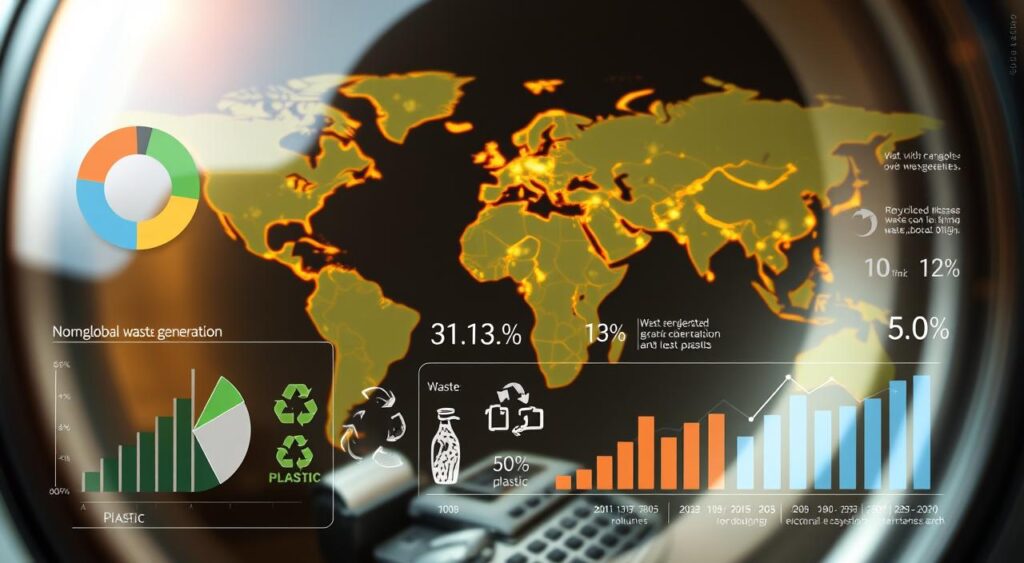
Compilation of Key Statistical Insights
The planet’s municipal solid waste output now exceeds 2.01 billion tonnes per year. This represents only part of the total refuse stream when industrial and construction debris are included.
Daily per capita figures show extraordinary disparity. They range from 0.11 to 4.54 kilograms across different nations. This forty-fold difference reflects vastly unequal consumption and disposal practices.
High-income nations contribute disproportionately to the total waste burden. Accounting for just 16% of the world’s population, they produce 34% of all discarded materials. This equals approximately 683 million tonnes annually.
Economic development fundamentally alters what societies throw away. Wealthier countries generate more packaging and recyclable dry materials. Poorer nations produce predominantly organic discards.
In the European Union, 2,233 million tonnes of refuse were recorded in 2022. This equates to 5.0 tonnes per capita. Major mineral waste from construction and mining constitutes 64% of this total waste.
Excluding mineral materials, EU refuse stood at 795 million tonnes. That’s 1.8 tonnes per inhabitant annually. These statistics confirm that consumption increases drive refuse growth faster than population expansion alone.
Environmental Impacts Stemming from Waste Growth
Beyond overflowing bins, the true cost of our consumption manifests in contaminated ecosystems and altered atmospheres. The environmental burden extends across air, water, and soil, creating a complex pollution problem.
When refuse is not managed properly, it degrades local environments and contributes to broader climate instability. This multi-faceted impact demands urgent attention.
Effects on Air, Water and Soil Quality
Air quality suffers from landfill gases and open burning. Methane and toxic fumes are released, harming public health and contributing to smog.
Water sources face contamination from leachate. This toxic liquid from dumpsites can seep into groundwater. Plastic debris also breaks down into microplastics, polluting rivers and oceans.
Soil health declines when heavy metals and chemicals accumulate. This can reduce agricultural productivity and allow toxins to enter the food chain.
Contributions to Greenhouse Gas Emissions
The disposal of solid waste is a major source of greenhouse gases. In 2016, these activities generated an estimated 1.6 billion tonnes of CO₂-equivalent.
This represented about 5% of total global emissions. A primary driver is organic material decomposing in landfills without proper gas collection systems.
Food discards alone account for nearly half of these emissions. The practice of open dumping, common in many regions, exacerbates the issue.
If practices do not improve, these emissions could reach 2.38 billion tonnes annually by 2050. Improving waste management is therefore a critical climate action.
Advances in Waste Management and Treatment
Modern systems for handling refuse prioritise recovery and reuse over mere disposal. This philosophical shift has driven significant technological progress over five decades.
Data reveals a mixed global picture. While 31% of discards are openly dumped, 19% are recovered via recycling and composting. In the European Union, 61.4% of refuse was treated in recovery operations during 2022.
Evolution of Recycling and Recovery Techniques
Recycling techniques have transformed dramatically. Sophisticated sorting facilities now use optical sensors and artificial intelligence to identify materials. This boosts purity and efficiency.
Organic treatment through anaerobic digestion also creates renewable energy. These methods divert food and garden refuse from landfills.
Innovations in Waste Treatment Systems
Treatment systems now include advanced thermal processes with energy recovery. Innovations like mechanical biological treatment stabilise refuse before landfilling.
Chemical recycling offers new pathways for complex plastics. Despite these advances, appropriate solutions must align with local infrastructure and economic reality.
Economic Implications and Urbanisation Effects
Managing society’s discards is not just an environmental task but a complex economic puzzle for city planners and finance ministers worldwide. The fiscal strain of handling municipal solid waste escalates as volumes grow and environmental rules tighten.
Cost Challenges in Municipal Solid Waste Management
Financing these systems is a major hurdle, especially for daily operations. Affluent countries often spend over $100 per tonne on integrated waste management. Lower-income nations pay about $35 but struggle far more to recoup these costs.
This labour-intensive work sees transport alone costing $20-$50 per tonne. User fees highlight the disparity, averaging $35 yearly in poor countries versus $170 in rich ones.
| Cost Factor | High-Income Countries | Low-Income Countries |
|---|---|---|
| Operating Cost per Tonne | > $100 | ~ $35 |
| Annual User Fee (Average) | $170 | $35 |
| Urban Collection Rate | Nearly 100% | ~48% |
| Typical Cost Recovery | Full or near-full |
Local governments usually fund half of infrastructure investments. National subsidies and private firms cover the rest.
Urbanisation concentrates population and refuse, straining existing systems. It creates demand for reliable services while pushing landfill costs higher. In poorer nations, subsidies for solid waste management must compete with other vital public needs.
Policy and Regulatory Frameworks in Waste Management
Policy development provides the essential structure for effective material recovery systems. Nearly 70% of nations have established dedicated institutions for oversight.
About two-thirds have created targeted legislation. Enforcement rates and capacity vary drastically between different countries.
EU and UK Policy Responses
The European Union’s Waste Framework Directive sets a clear hierarchy. It prioritises prevention, reuse, and recycling over disposal.
EU aims include strict landfill diversion and extended producer responsibility. The UK maintains alignment with these principles post-Brexit.
Its own framework features plastic taxes and deposit return schemes.
Local Government Initiatives and Partnerships
About 70% of services are overseen by local public entities. Direct central government provision is uncommon.
Half of all services from collection to disposal are publicly operated. One-third involve public-private partnerships.
These partnerships can bring private capital and expertise to the sector. Success requires careful contract management to protect public interests.
Future Projections and Emerging Challenges
Projections to 2050 reveal a future where material output vastly outpaces human population expansion. The coming decades present a dual challenge: managing soaring volumes and mitigating their environmental impact.
Projected Growth Rates Through 2050
By 2050, the planet’s total waste is expected to reach 3.40 billion tonnes per year. This is a 70% increase from current levels.
This growth will far exceed the rate of population growth. Daily per capita discard in high-income nations may rise 19%. In lower-income countries, it could surge over 40%.
| Region | Projection to 2050 | Key Driver |
|---|---|---|
| Sub-Saharan Africa | Total refuse to more than triple | Rapid urbanisation |
| South Asia | Total output to double | Economic development |
| Middle East & North Africa | Total output to double | Changing consumption |
| Global Aggregate | 70% overall increase | Combined factors |
If no improvements are made, emissions from solid waste could hit 2.38 billion tonnes of CO₂-equivalent each year.
Technological and Sustainable Solutions
Addressing this requires integrated strategies. Solutions must combine prevention, better infrastructure, and systemic change.
Plastic waste is a critical focus. Its persistence and limited recycling need innovation. Chemical recycling and AI-powered sorting offer new pathways.
Sustainable answers also include circular economy models and policy shifts like producer responsibility. Success needs tailored approaches combining technology, finance, and governance.
Conclusion
The evidence from five decades of data presents an undeniable call for transformative action on society’s discards. Current volumes of municipal solid waste stand at 2.01 billion tonnes yearly, heading towards 3.40 billion by 2050.
This trajectory highlights stark inequalities. High-income countries produce a disproportionate share, yet the fastest growth now occurs where infrastructure is weakest. Environmental costs from landfill emissions and pollution are severe.
Progress exists, like the EU’s 40.8% recycling rate. However, widespread open disposal persists. Economic and policy hurdles remain significant.
Ultimately, integrated strategies—prevention, better collection, and circular models—are essential. The challenge is formidable, but a sustainable path is achievable with innovation and commitment.