London waste volumes and economy are closely connected, offering a surprisingly accurate snapshot of how the capital lives, builds, consumes, and grows. Every household bin, construction skip, and commercial collection reflects wider economic behaviour—often faster than traditional financial indicators.
By analysing waste data from local authorities and national reporting frameworks, it becomes possible to track shifts in spending habits, development cycles, and sustainability performance. From periods of rapid construction growth to times of economic slowdown, waste volumes move in clear and measurable patterns.

This article explores how rubbish data reveals economic reality, why London faces unique waste challenges, and how smarter resource management can support long-term urban resilience.
Key Takeaways
- Waste volumes rise and fall alongside economic activity
- Construction and commercial sectors are the biggest drivers
- Household waste reflects consumer confidence and lifestyle trends
- Recycling performance highlights infrastructure and behavioural gaps
- Circular economy models unlock economic and environmental value
Waste as an Economic Signal
Waste is not random. It is a direct outcome of production, consumption, and disposal choices. When businesses expand, offices refurbish, or housing developments increase, waste volumes rise rapidly. Conversely, during economic contractions, both commercial and household waste streams often decline.
Unlike financial reports, waste data captures physical economic activity. It reflects real actions rather than projections, making it a valuable supplementary indicator for planners, councils, and sustainability professionals.
London’s size and density amplify these signals. Small percentage changes translate into millions of tonnes of material moving through the system each year.
London’s Transition Away from Landfill
Historically, London relied heavily on landfill disposal. For decades, waste was transported by road and river to sites outside the city. Rising landfill taxes, environmental pressures, and space constraints forced a gradual shift toward alternative treatment methods.
The closure of major landfill facilities marked a turning point. Since then, the capital has invested in recycling infrastructure, energy-from-waste plants, and advanced sorting technologies. However, progress has been uneven due to land availability, funding constraints, and population growth.
Recycling Performance in a Dense Urban Environment

London continues to trail behind other UK regions in recycling rates. High-density housing, limited storage space, and complex tenancy arrangements all contribute to lower participation levels.
Unlike rural or suburban areas, many residents lack access to private bins or convenient sorting facilities. Short-term rentals and frequent population turnover further complicate education and engagement efforts.
Despite these barriers, recycling volumes have slowly increased, showing that targeted investment and consistent messaging can still deliver results.
Construction Waste and Development Cycles
Construction and demolition generate the largest waste stream in the UK. In London, this sector plays an outsized role due to constant redevelopment, infrastructure upgrades, and housing demand.
Construction Waste Trends
| Activity Type | Waste Impact | Economic Link |
|---|---|---|
| Residential builds | High | Housing demand |
| Commercial refurbishments | Moderate–High | Business growth |
| Infrastructure projects | Very High | Public investment |
While recovery rates are strong nationally, London struggles to process all materials locally. Significant volumes are transported elsewhere, increasing costs and emissions while exporting economic value.
Household Waste and Consumer Behaviour
Household waste trends closely mirror lifestyle and spending habits. During periods of rising disposable income, volumes increase—especially packaging, furniture, and food waste. Economic uncertainty often leads to reduced consumption and more conservative disposal patterns.
Seasonal behaviour also plays a role. Spring cleaning, moving periods, and festive seasons create predictable spikes that councils and service providers must plan for.
Understanding these patterns helps align collection schedules, recycling campaigns, and infrastructure investment more efficiently.
Commercial Waste and Business Confidence
Commercial waste volumes act as a real-time barometer for business activity. Retail, hospitality, and office sectors generate diverse material streams that fluctuate with foot traffic, employment levels, and consumer spending.
Businesses increasingly view waste management as a cost-control and sustainability strategy rather than a compliance obligation. Efficient segregation reduces disposal costs, while improved recycling performance supports environmental targets and public reputation.
The relationship between London waste volumes and economy is particularly visible in commercial districts, where rapid changes in occupancy or retail demand quickly affect collection volumes.
Infrastructure Constraints and Economic Costs
Only a portion of London’s waste is processed within city boundaries. Space limitations and planning restrictions mean that millions of tonnes must be transported elsewhere each year.
This creates multiple economic pressures:
- Higher transport and fuel costs
- Increased carbon emissions
- Dependency on external treatment facilities
- Reduced local economic retention
Investing in local processing capacity keeps value within the region and reduces long-term system vulnerability.
Learning from Infrastructure Failures
Large-scale incidents within urban waste systems highlight the economic impact of everyday disposal habits. Blockages, contamination, and improper sorting lead to costly emergency interventions and service disruptions.
These events underline the importance of public education and consistent enforcement. Prevention is far cheaper than remediation.
Circular Economy: Turning Waste into Value
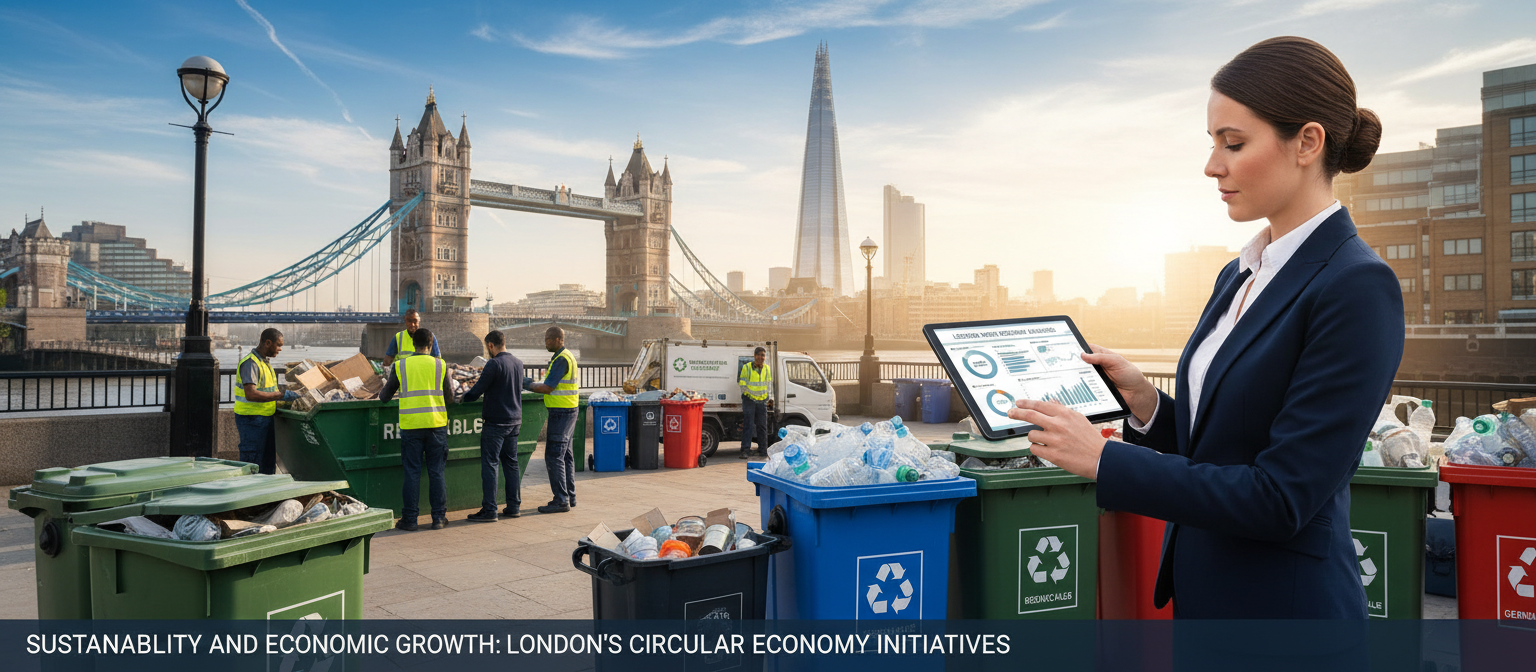
The circular economy reframes waste as a resource rather than an endpoint. By extending product life cycles and recovering materials, cities reduce dependency on raw resources while creating economic opportunity.
Key circular strategies include:
- Reuse and repair schemes
- Construction material salvage hubs
- Organic waste composting
- Energy recovery from non-recyclables
For London, adopting circular principles helps offset land scarcity while supporting job creation and innovation.
Policy, Regulation, and Economic Direction
Government targets strongly influence waste system performance. Recycling goals, landfill diversion requirements, and producer responsibility schemes shape investment decisions across the sector.
Extended producer responsibility shifts financial accountability upstream, encouraging better product design and reduced packaging waste. Over time, this reduces pressure on councils and taxpayers.
Policy alignment is critical for ensuring that environmental goals support—not hinder—economic growth.
Why Waste Data Matters for City Planning
Waste statistics inform decisions far beyond bin collection. They influence:
- Infrastructure investment planning
- Transport network design
- Energy recovery capacity
- Climate action strategies
Planners increasingly use waste metrics alongside housing, transport, and employment data to model future needs more accurately.
A clear understanding of London waste volumes and economy enables smarter, evidence-based urban development.
Future Outlook: Smarter Systems, Better Outcomes
London’s waste challenges will intensify as population density increases. Digital tracking, smarter logistics, and behavioural nudges will become essential tools for managing complexity.
Technology, policy, and public engagement must evolve together. Cities that integrate these elements successfully will reduce costs, lower emissions, and improve quality of life.
Conclusion
Waste is more than an environmental issue—it is a mirror of how a city functions. London’s disposal patterns reveal economic cycles, consumer behaviour, and infrastructure strengths and weaknesses.
By recognising the connection between London waste volumes and economy, policymakers, businesses, and residents can make more informed decisions. Embracing circular solutions and data-driven planning transforms waste from a challenge into a long-term asset.