Rubbish presents a profound civilisation problem, affecting communities worldwide. Large cities across Asia, America, and Europe face immense challenges related to trash and environmental pollution.
Landfills pose serious threats to health and life. They can become habitats for disease and present risks of difficult fires and gas emissions.
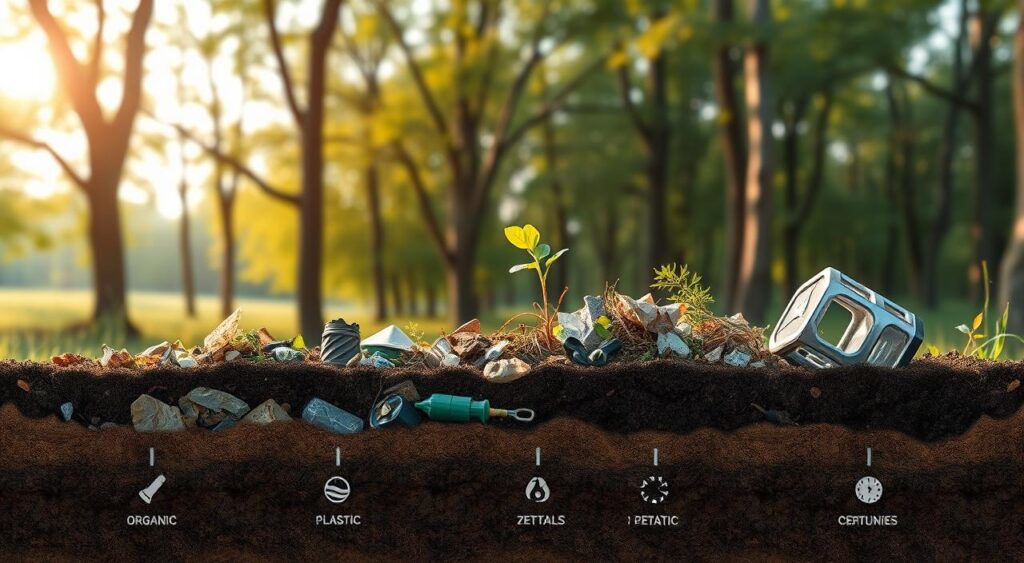
Every item we use, from a toothbrush to a foam container, remains on our planet. It either stays in its original form, gets recycled, or slowly breaks into microplastics.
The period materials take to break down varies enormously. Organic matter may vanish in days, while synthetic substances can persist for millennia.
A crucial fact is that for many modern materials, we simply do not know the full waste decomposition time. Plastic, for instance, has only been common since 1907, so experts can only estimate.
This information is vital. Understanding these timelines helps us grasp the long-term impact of our consumption on daily life and the natural world.
Key Takeaways
- Rubbish accumulation is a major global environmental problem affecting urban centres.
- Landfills and waste sites present significant risks to public health and safety.
- Every manufactured item persists in some form, often breaking down into microplastics.
- The breakdown period for different materials ranges from a few days to thousands of years.
- For many modern synthetics, the full decomposition timeline remains unknown.
- Understanding this information is key to making informed choices about consumption and disposal.
Understanding the Process of Waste Decomposition
When we throw something away, its fate is determined by invisible biological and chemical forces. This breakdown occurs in two distinct ways. For items derived from nature, like food scraps, true decomposition is carried out by microbes.
For man-made materials, a different process of physical degradation takes place. Understanding this distinction is key to grasping why different items persist in the environment.
The Role of Natural Elements and Microorganisms
Bacteria and fungi are nature’s recyclers. They consume organic material, breaking it down into simpler substances. To thrive, these organisms need specific conditions.
Oxygen is crucial for efficient aerobic decay. Without it, the process slows dramatically. Water is also essential for microbial life, but balance is key.
Too much water drives out air and halts this natural way of breaking things down. This is why rubbish in compacted landfills often degrades so slowly.
How Temperature and Humidity Influence Decay
Heat and moisture are the primary drivers of breakdown rates. Warm, humid conditions accelerate microbial activity, speeding up decomposition.
In cooler, drier climates, the opposite occurs. Each type of substance reacts differently to these factors. This explains the vast difference in breakdown time between a tropical forest and an Arctic landfill.
Extremes of either factor can stop the process entirely. Managing these conditions is a major challenge in handling our discarded materials.
Waste Decomposition Time in Everyday Materials
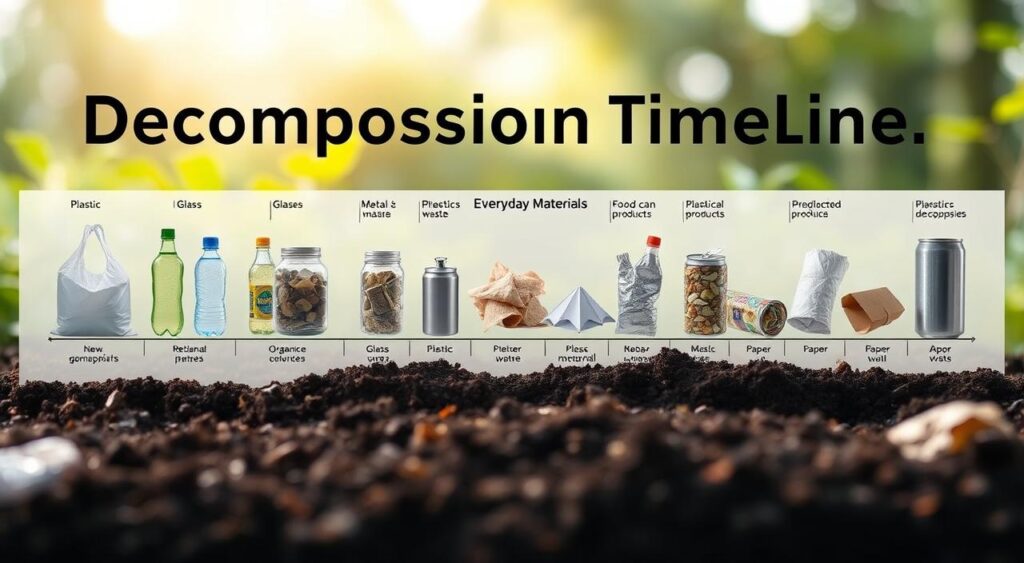
The everyday items we discard have vastly different lifespans in our environment. Common household rubbish can vanish in weeks or persist for centuries.
Paper and Cardboard: From Newsprint to Tissue
Newsprint may break down in just six weeks. Cardboard and tissues can take about three months.
Recycled paper saves vital resources. One tonne spares 17 trees.
Metal and Aluminium: Corrosion and Longevity
A standard steel can might corrode in ten years. Aluminium drink cans resist this process far longer.
They can remain in a landfill for up to 200 years.
Plastic and Glass: Durability Under Natural Conditions
Plastic is notoriously persistent. Thin grocery bags last around 20 years.
Water bottles and styrofoam can endure for 450 to 500 years. Glass may never fully degrade, lasting millennia.
Other Waste Items: Food Waste, Tyres, and More
Organic food scraps decompose in days or weeks. Rubber tyres, however, are built to last.
They can take over 80 years to break apart. These contrasts highlight our complex rubbish legacy.
Innovative Recycling Solutions and Environmental Impact
Hope for a cleaner planet lies in cutting-edge recycling methods and material science. This shift in focus explores practical ways to reduce pressure on our environment.
Advancements in Biodegradable Plastics and Alternative Materials
Scientists are creating new biodegradable plastics from plants like corn. They are also tweaking petroleum-based plastics to break down more easily in nature.
A groundbreaking discovery is bacteria that consume plastic as food. This innovation could revolutionise how we handle this persistent material.
Recycling and Reusing: Reducing Landfill Pressures
Glass and aluminium can be recycled endlessly without quality loss. This makes them highly sustainable when properly managed.
Many plastics and papers can be reprocessed into new products multiple times. Even a few uses are far better than centuries in landfill.
The Broader Environmental Benefits of Effective Waste Management
Proper rubbish handling prevents methane emissions and water contamination. It also conserves natural resources and protects ecosystems.
Composting food scraps, for instance, turns a potential problem into a useful resource. These actions collectively support a healthier environment for all life.
Conclusion
The lifespan of discarded items reveals a critical story about our modern world. This information empowers us to make smarter choices.
While nature has efficient systems for breaking things down, many synthetic materials resist this decomposition. This creates persistent challenges in our landfills and natural spaces.
Practical solutions are within our reach. Prioritising reusables and participating in local recycling programmes are powerful steps. Properly sorting rubbish protects our environment.
Collective action, driven by knowledge, can significantly reduce our impact. Everyone’s choices matter for a healthier planet.