Most people rarely think about what happens after rubbish leaves their home or workplace. This is no accident. Modern waste infrastructure London relies on is designed to function quietly, efficiently, and out of sight. When it works, life continues uninterrupted. When it fails, the impact is immediate, visible, and costly.
London produces millions of tonnes of waste every year. Households, offices, hospitality venues, construction sites, and retailers all contribute to this complex system. Yet only major incidents—blocked sewers, collection disruptions, or missed recycling targets—force the system into public view.

Understanding how London’s waste systems developed, where current pressure points lie, and how innovation is reshaping the sector is essential for businesses, policymakers, and residents alike.
Key Takeaways
- Waste systems are designed to be invisible, not forgotten
- Failures expose how dependent cities are on resilient infrastructure
- London’s waste journey has shifted from landfill to recovery and recycling
- Businesses generate a significant share of total waste volumes
- Accurate local planning is essential for long-term sustainability
- Technology and policy must work together to meet recycling targets
A Brief History of London’s Waste Journey
From Landfill Dependence to Modern Systems
Until the late 20th century, landfill dominated waste disposal across the UK. Large sites outside the capital absorbed enormous volumes of rubbish transported by road and river.
One of the most significant sites was Mucking Marshes, located in Essex. Barges travelled daily along the Thames carrying waste from London to this vast landfill. While efficient at the time, the environmental cost was high.
By the mid-1990s, growing awareness of climate change, land scarcity, and pollution made this approach unsustainable.
Policy Shifts and Environmental Awareness
The early 2000s marked a turning point. Under the leadership of Ken Livingstone, London adopted stronger environmental policies. Rising landfill taxes and stricter regulations pushed authorities toward alternatives such as recycling and energy recovery.
The closure of Mucking Marshes in 2010 symbolised the end of an era and accelerated investment in modern waste treatment.
Recycling and Energy Recovery: A Strategic Shift
Landfill taxation dramatically changed the economics of waste disposal. Burying waste became expensive, while recycling and incineration with energy recovery became financially viable.
Modern energy-from-waste facilities now generate electricity and heat from non-recyclable materials. These plants reduce landfill dependency while supporting renewable energy goals.
At the same time, recycling programmes expanded. Separate collections, improved public education, and better sorting technology helped divert increasing volumes from disposal.
Benefits of this transition include:
- Reduced greenhouse gas emissions
- Energy generation from residual waste
- Lower long-term disposal costs
- Stronger alignment with circular economy principles
When Waste Infrastructure Fails: The Fatberg Wake-Up Call

In 2017, a massive blockage beneath Whitechapel shocked Londoners. The so-called “fatberg” stretched over 250 metres and weighed more than 130 tonnes.
What Caused the Fatberg?
The blockage formed from fats, oils, wet wipes, and non-flushable items. Both household behaviour and commercial food waste practices contributed to its growth.
Restaurants disposing of grease improperly combined with residents flushing unsuitable materials down drains. Over time, the accumulation hardened into a concrete-like mass.
Why It Mattered
Removing the fatberg took weeks of specialist work. During decomposition, harmful gases threatened sewer integrity and water quality.
More importantly, the incident highlighted how individual actions directly affect city-wide infrastructure. Waste systems are interconnected, and misuse at one point can trigger widespread disruption.
London’s Recycling Targets and Government Initiatives
London has set ambitious environmental goals. Central to these efforts is the Circular Economy Route Map, which aims to move beyond a “use and dispose” model.
This strategy focuses on:
- Reducing waste generation
- Encouraging reuse and repair
- Improving recycling quality and rates
- Keeping materials in circulation longer
The target of 50% recycling by 2025 and 65% by 2030 represents a significant challenge. Current rates show progress, but the gap remains substantial.
Achieving these targets requires coordinated efforts across boroughs, consistent data tracking, and investment in modern infrastructure.
Operational Innovation in Waste Services
Modern waste service providers operate very differently from traditional collectors. Advanced logistics, cleaner vehicle fleets, and detailed material tracking now define best practice.
| Operational Area | Traditional Model | Modern Approach |
|---|---|---|
| Vehicle Fleet | Diesel vehicles | Electric & low-emission fleets |
| Collection Schedule | Fixed weekly | Flexible 7-day services |
| Sorting | Limited separation | Up to 99 material streams |
| Environmental Goal | Partial diversion | Zero waste ambition |
Innovative providers demonstrate how operational efficiency and environmental responsibility can align. Flexible collections reduce disruption for businesses, while detailed sorting maximises recycling outcomes.
The Importance of Accurate Planning and Local Data
A landmark 2014 study by Imperial College London, commissioned by Veolia, revealed serious flaws in national waste forecasting.
Government models suggested sufficient disposal capacity across England. However, regional analysis showed significant undercapacity, particularly in urban areas like London.
The study highlighted that:
- National averages mask local shortages
- Transporting waste long distances is unsustainable
- Regional planning is essential for resilience
Empowering local authorities to assess their own capacity needs is now widely recognised as critical for long-term infrastructure stability.
Public and Private Sector Collaboration
Effective waste infrastructure depends on strong partnerships. Public authorities set regulations and targets, while private operators deliver services and invest in technology.
Companies such as Bywaters provide tailored solutions for businesses, helping them improve sustainability performance while remaining compliant.
These collaborations combine policy direction with operational expertise, producing outcomes that neither sector could achieve alone.
Waste, Public Health, and Environmental Protection
When waste systems operate effectively, they protect public health in ways most people never notice.
Failures, however, can lead to:
- Water contamination
- Air quality issues
- Increased disease vectors
- Environmental degradation
Improved recycling and recovery reduce landfill emissions, while cleaner collection vehicles lower urban air pollution. Each improvement supports broader climate and health objectives.
Why Businesses Must Understand Waste Infrastructure
Commercial waste accounts for roughly one-third of London’s total waste output. Offices, hospitality venues, and construction sites all produce specialised waste streams.
Smart waste management offers businesses tangible benefits:
- Lower disposal costs through segregation
- Improved environmental credentials
- Regulatory compliance
- Better reporting and sustainability tracking
Professional services help organisations navigate complex requirements while supporting city-wide goals.
For deeper insight into responsible disposal practices, see our internal guide on commercial waste management strategies in London.
Technology Transforming Waste Treatment
Today’s facilities are highly sophisticated. Optical scanners, magnets, air separation, and AI-powered systems enable precise material recovery.
Organic waste is processed through anaerobic digestion, producing biogas and fertiliser. Residual waste is treated in energy recovery facilities with strict emission controls.
These innovations allow materials once considered unrecyclable to re-enter the economy, supporting long-term sustainability.
Policy Frameworks and Local Authority Challenges
Regulatory frameworks guide waste infrastructure development, but challenges remain:
- Limited funding for new facilities
- Staffing constraints in local authorities
- Coordination across multiple boroughs
Balancing national consistency with local flexibility is essential. Tailored solutions work better than one-size-fits-all planning.
Environmental and Economic Implications
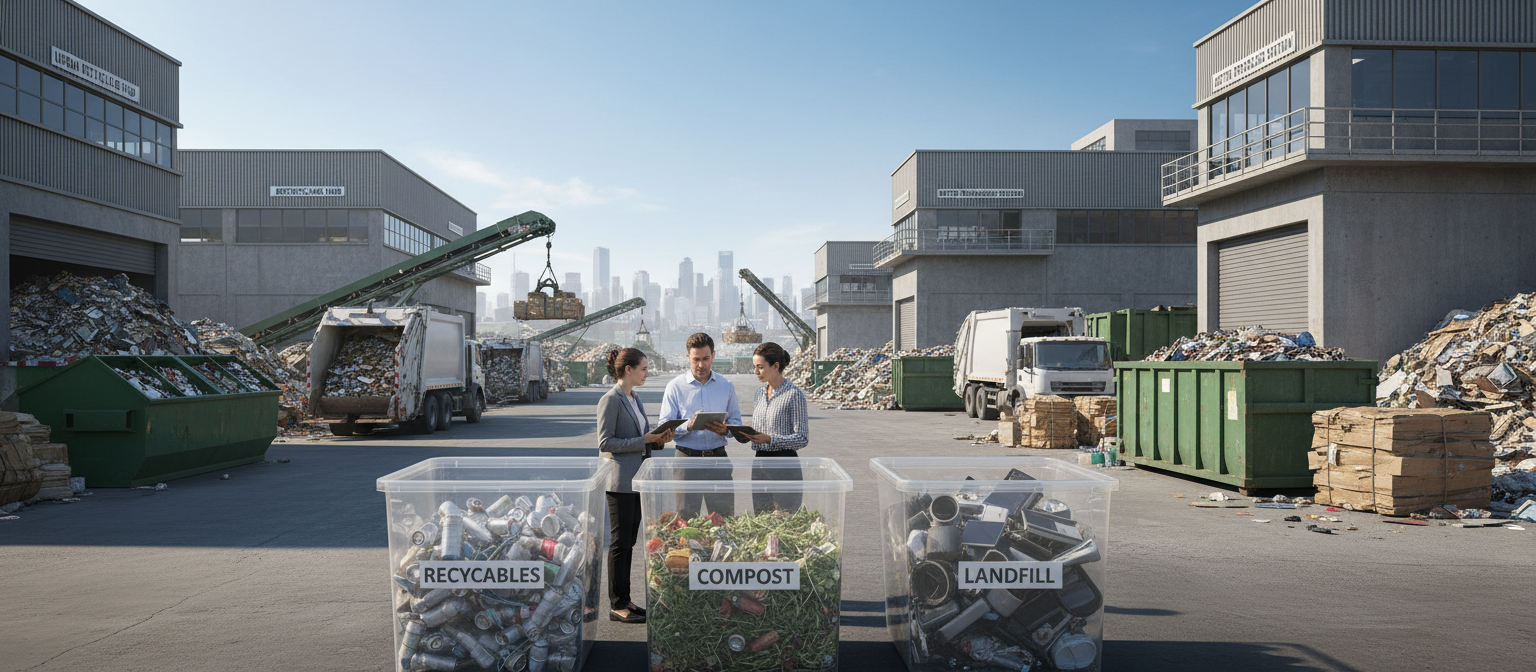
Waste management is not just an environmental issue—it is an economic one.
| Practice | Environmental Impact | Economic Effect |
|---|---|---|
| Landfill | Methane emissions | Long-term remediation costs |
| Recycling | Resource conservation | Job creation |
| Energy Recovery | Reduced fossil fuel use | Energy revenue |
Recovering materials saves energy compared to producing new products. Circular approaches turn waste into an asset rather than a burden.
The Future of Waste Infrastructure in London
The future lies in prevention, reuse, and smarter systems. Repair initiatives, sharing platforms, and reusable packaging reduce waste at source.
Digital tracking, AI sorting, and decentralised facilities will further strengthen resilience. Meeting 2030 targets requires sustained effort, but the foundations are already in place.
Conclusion
London’s waste systems may be invisible most of the time, but they are essential to the city’s health, economy, and sustainability. From landfill dependence to advanced recycling and recovery, the journey has been significant.
Yet challenges remain. Accurate local planning, continued investment, and shared responsibility are crucial for progress.
By understanding how waste infrastructure London depends on functions behind the scenes, businesses and residents can make informed choices that support a cleaner, more resilient city for future generations.