Managing your household rubbish and recycling across Britain can feel confusing. This is because there is no single national standard for these services.
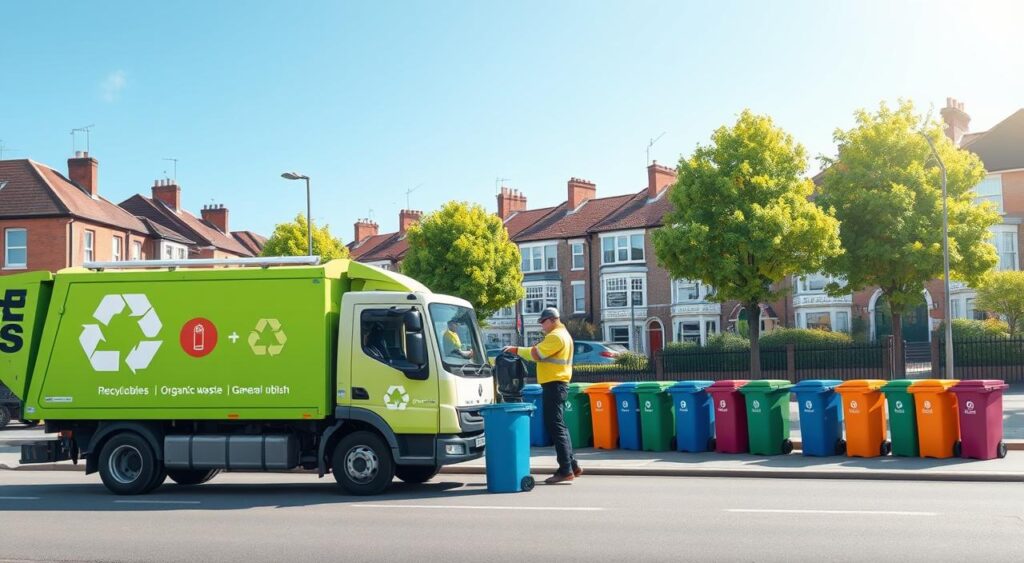
The entire infrastructure is undergoing a significant transformation right now. Local authorities and networks are working to standardise how materials are gathered and processed.
This push for change is supported by public willingness. Recent research indicates that 63% of Brits are ready to sort their recycling into four or more separate bins.
How we handle these materials from the kerbside plays a fundamental role. It determines what can be successfully reprocessed and kept in use.
Our guide provides a clear breakdown of the different approaches used by councils. It will help you navigate the requirements and understand the shift towards a more efficient circular economy.
Key Takeaways
- Household rubbish and recycling services differ greatly depending on your local council.
- A major national effort is in progress to standardise these services across the country.
- Public support for detailed sorting of recyclables is remarkably high.
- The kerbside collection method directly influences recycling quality and success rates.
- Knowing your local rules is crucial for ensuring materials are processed correctly.
- The overall goal is to reduce landfill and incineration, supporting a circular economy.
Understanding the UK waste collection system
A complex patchwork of methods exists for gathering household materials destined for disposal or reuse. Your local council designs the specific framework you follow. They must consider existing contracts, budgets, and local infrastructure.
Defining Collection Methods and Bin Variations
The number of containers per home differs widely. You might use wheeled bins, boxes, kerbside caddies, or disposable sacks. A study of 359 local authorities examined how the count of bins links to recycling performance.
Where a council operates multiple schemes, researchers assigned the dominant one. This helps show clear trends in how setup affects outcomes.
Importance of Local Council Strategies
Council strategies are crucial. They must balance meeting national recycling targets with on-the-ground practicalities. Local rules and investment directly influence success rates for households.
Their decisions shape the entire service you receive. Effective planning ensures materials are processed correctly and supports broader environmental goals.
Exploring Different Recycling Collection Methods in the UK
Sorting your household recycling involves navigating one of three primary systems used by local authorities. Your council’s chosen method sets the rules for your area.
The main frameworks for handling recyclable materials are:
- Comingled: All items go into one bin.
- Two-stream: Materials are separated into two containers.
- Multi-stream: Sorting into three or more bins.
Comingled Systems: Pros and Cons
This single-bin approach is the most common collection method. Nearly half of all councils use it.
The big advantage is convenience. You don’t need to sort plastic, glass, or paper at home.
However, mixing materials leads to more contamination at processing plants. This results in lower overall recycling rates compared to other systems.
Two-Stream and Multi-Stream Systems Explained
Two-stream services typically keep paper and card apart from other materials. This simple separation helps improve quality.
Multi-stream frameworks require households to sort items into at least three different bins. Some councils, like Conwy in Wales, use many more for specific materials.
This detailed sorting significantly reduces contamination. It allows for more plastic, glass, and organic waste to be successfully reprocessed.
Impacts of Collection System Variations on Recycling Rates
Data from across the nations reveals a strong link between service setup and the quality of outcomes. The method your council uses directly influences how much material is kept in use.
Performance figures vary dramatically depending on local rules and infrastructure.
Linking the Number of Bins to Recycling Efficiency
Research shows a clear trend. Areas with four or more containers generally boast better reprocessing rates.
This detailed sorting at home keeps materials cleaner and more valuable. Despite this, most local authorities (53%) currently provide residents with three or fewer bins.
Regional Case Studies: Wales, England, Scotland and Northern Ireland
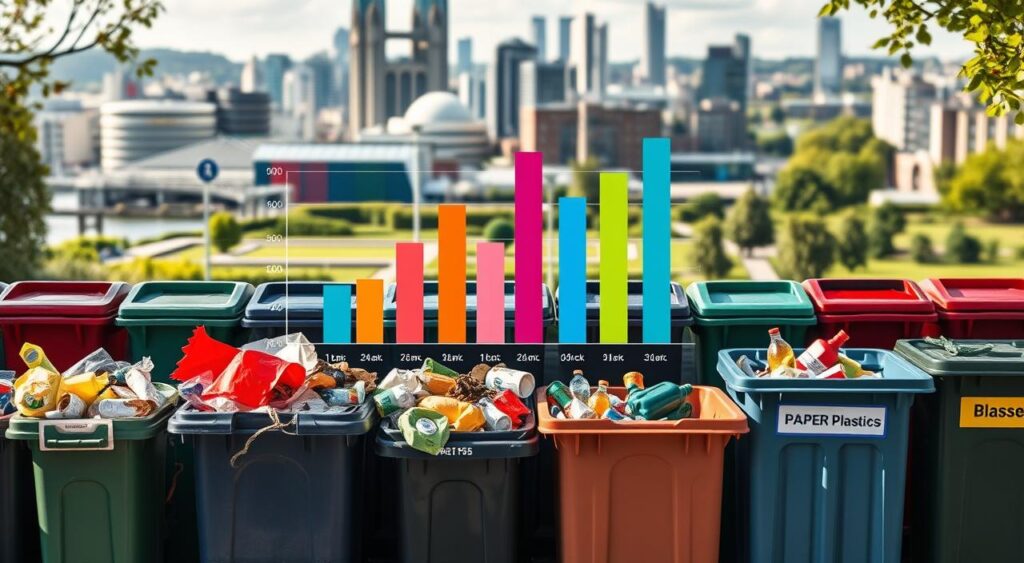
National data highlights stark contrasts. Wales reported an impressive rate of 66.6% for 2023/24.
This significantly outperforms England (43.4%) and Scotland (43.5%). Wales’s consistent approach, driven by mandated targets and investment, is a key factor.
Figures for England came from Defra, Scotland from SEPA, Wales from WRAP, and Northern Ireland from DAERA.
The Role of Local Authorities and Their Investment in Recycling Infrastructure
Grants from Defra are empowering councils to overhaul their services ahead of new mandatory rules. This financial support is crucial for modernising how materials are handled locally.
Local authorities are the key players in this transformation. Their strategic spending directly shapes the quality and efficiency of the services residents receive.
Budget Considerations and Funding Initiatives
The Department for Environment, Food, and Rural Affairs has provided more than £340m in grants. This targeted support helps councils prepare for upcoming changes.
Balancing budget constraints with upgrade needs is a major challenge. Investment in new facilities and vehicles is essential to meet policy goals and boost national performance.
| Investment Area | Example Use | Primary Goal |
|---|---|---|
| New Sorting Facilities | Processing comingled materials more effectively | Reduce contamination, improve output quality |
| Fleet & Container Upgrades | Providing households with more standardised bins | Increase capture rates, streamline operations |
| Digital Systems & Education | Using WRAP’s Local Authority Portal for planning | Enhance service categorisation and public communication |
How Local Infrastructure Shapes Waste Management
The physical infrastructure a council controls dictates what is possible. Modern sorting plants and reliable collections are fundamental.
Tools like WRAP’s portal help categorise services and bin numbers. This data is vital for planning effective upgrades across different regions.
Ultimately, this investment determines how much material is successfully reprocessed. It is the foundation for improving national recycling rates.
Navigating the New Simpler Recycling Reforms and Bin Collection Rules
The government’s Simpler Recycling initiative introduces major changes to bin rules across England. Its goal is to create consistent recycling rules for all households and businesses.
These new rules will standardise what goes into each container. This shift aims to boost national reprocessing rates.
Implementation Timeline: From March 2025 to 2027
Businesses must separate core streams like dry recyclables and food waste from March 2025.
From 31 March 2026, councils must provide separate collections for food waste, paper cardboard, and other dry materials. A BBC investigation found 79 English councils may miss this deadline.
Plastic film collections should expand by 2027. This completes the Simpler Recycling rollout.
Household vs Business Implications
For residents, it often means receiving a new bin for organic waste. Businesses face stricter sorting duties from the start.
Some local authorities have secured delays for food waste collections. Costly long-term contracts are the cause. This creates a patchy rollout of the Simpler Recycling system.
Environmental Implications and Future Trends in Waste Management
The consequences of sending valuable resources to be buried are catalysing a shift towards smarter practices. This evolution focuses on cutting environmental harm and unlocking economic value from what we discard.
Reducing Landfill Dependency Through Efficient Recycling
Keeping recyclable materials in circulation is vital. A recent DS Smith report warns that 17.3 million tonnes of paper and cardboard, worth £2.8bn, could be sent landfill by 2030. This highlights a huge opportunity for improvement.
Diverting food waste is equally critical. When this organic matter decomposes in landfill, it produces methane, a potent greenhouse gas. Conversely, recycling one kitchen caddy can generate enough power for a fridge to run for 18 hours.
Practical steps make a difference. Lining your food caddy helps prevent mess and pests. The nation currently ranks 25th in Europe for paper and card recycling rates. Boosting these figures is essential for a true circular economy.
Conclusion
The journey towards a more sustainable future for our resources is now firmly underway. National recycling targets are driving a major evolution in local waste management.
Standardising rules through the Simpler recycling reforms is key. It will cut the confusion that harms material quality and rates.
Local authorities and councils are central to this shift. Their investment in new infrastructure will decide the success of these national policies over time.
Households and firms must get ready for new collections, especially for food. This move to a consistent national system is vital.
It will drastically reduce landfill use and build a stronger circular economy. Everyone has a role in making this new approach to waste management work.